Why Location Still Wins in Coastal Real Estate: A Fort Myers Beach Perspective
In every real estate cycle, certain variables shift—interest rates, construction costs, regulations, and market sentiment. One variable does not: location.
On Fort Myers Beach, this truth has become even clearer in the years following Hurricane Ian. As redevelopment moves forward, prime coastal locations continue to attract attention, capital, and long-term confidence despite higher barriers to entry.
Location as the Constant Through Market Cycles
Coastal real estate is uniquely cyclical, yet location consistently outperforms across those cycles.
Well-positioned sites benefit from:
Enduring demand tied to water access and views
Limited ability for new supply to compete
Strong emotional and lifestyle appeal
Long-term pricing power
On a barrier island like Fort Myers Beach—where land boundaries are fixed—location becomes even more decisive.
Why Barrier Islands Amplify the Value of Location
Unlike mainland markets, barrier islands cannot expand outward. Infrastructure, environmental protections, and geography create natural limits.
As a result:
Prime waterfront and gateway sites are irreplaceable
Poorly located parcels struggle to justify redevelopment costs
Well-located properties carry strategic importance beyond their acreage
This dynamic concentrates redevelopment activity around sites that can support long-term vision and resilient design.
Royal Beach Club and the Power of Positioning
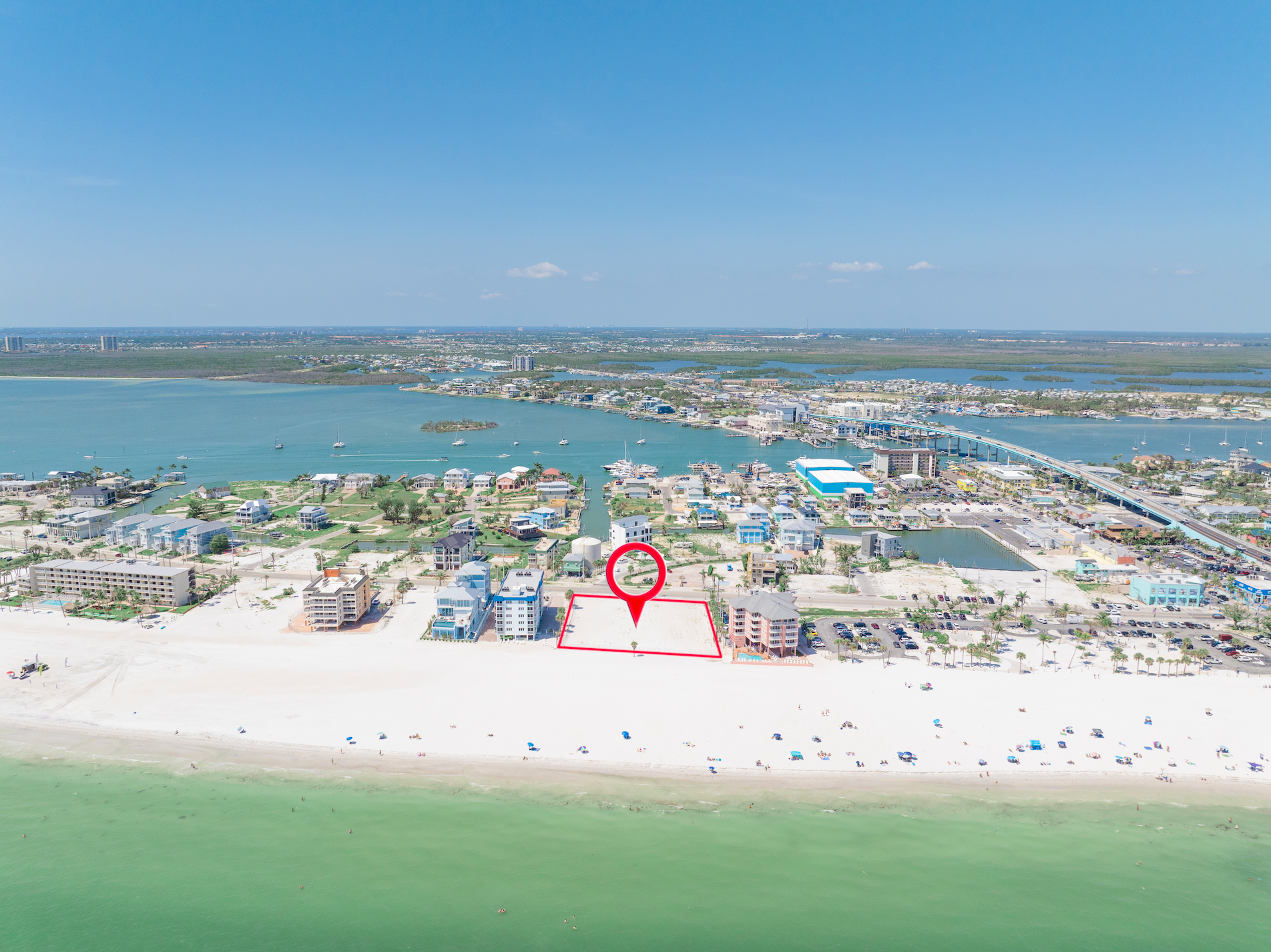
Royal Beach Club’s location at the northern entrance to Estero Island places it within a rare category of Gulf-front properties.
Gateway visibility, direct Gulf access, and proximity to established dining, marina, and tourism anchors reinforce its long-term relevance. In a post-storm environment, these attributes matter more—not less—as developers and investors prioritize sites that can justify higher redevelopment thresholds.
Location, in this context, is not just about views—it’s about influence.
When Costs Rise, Location Matters More
Rising construction and insurance costs have reshaped coastal redevelopment economics.
As costs increase, marginal sites are often removed from consideration. Prime locations, however, remain viable because they support revenue durability and long-term appreciation.
On Fort Myers Beach, this has led to a more refined market—one where redevelopment activity concentrates around the island’s most strategic parcels.
Location and Long-Term Confidence
Investors with a long-term horizon understand that while buildings change, land does not.
Location-driven confidence supports:
Patient capital investment
Higher-quality design and construction
Projects that contribute to the island year-round
Royal Beach Club reflects this mindset—where confidence in place underpins redevelopment strategy.
Looking Ahead
As Fort Myers Beach continues to redefine itself, location will remain the foundation upon which its future is built.
Market conditions will evolve, but the island’s most well-positioned sites will continue to anchor value, shape experience, and influence redevelopment outcomes. In coastal real estate, location doesn’t just matter—it endures.